How far into the ground can you place a water tank?

Some people, when they buy or have a water tank installed would like to bury their tank, this can be done to reduce the height of the tank – especially if it is blocking the view, or to hide it away completely. Steel tanks will corrode if buried, so, for that reason, they are best left above ground, however concrete in ground water tanks can be buried, as can poly water tanks.

When it comes to poly tanks it’s important that you just don’t bury *any* poly tank. Those standard *above ground* tanks have not been designed to withstand the pressures of the earth and if they are not properly supported they can collapse due to the outside pressure. Having said that you can partially bury a poly water tank.

Before you start burying an in-ground water tank it’s important to get the advice of an engineer as the desired depth, type of soils and the location needs to be evaluated by an expert before partially burying your tank. This is to ensure foundations are not eroded and your tank will be properly supported.

It’s best not to bury a poly tank more than 1 metre into the ground and your hole should be 300mm or 12 inches wider than the diameter of the base of your water tank. If you plan to bury two tanks you need to dig two separate holes. You must prepare the foundations for your tank as normal, that is it must still sit on a compact, level and flat base. Bases can include concrete, brick, gravel or solid dolomite between 300mm and 400mm deep.

Ensure that the surrounding soil left in the walls of the hole are solid if there is any major water seepage into the hole from the surrounding soil the site will not be suitable

Once the tank has been placed on the base, fill your tank with water then backfill the hole with cement powder and crusher dust compact just 75 to 100mm at a time.

It’s important that tanks be buried into the ground only half way up its wall height and that your outlet that picks up from the tank comes through the tank roof, or alternate plumbing from the base outlet is needed. If there are 2 x 90mm inlets coming into the tank, you will need at least 2 x 90mm overflow pipes. Overflow must be piped away from the tank

You can bury your poly tank completely – you just have to buy a tank that has been designed to be an in-ground water tank. In-ground tanks are designed to provide you with a wholly hidden water storage solution, they are suitable for installation under a driveway, pathway or garden.


Read Also:

Harvesting Rainwater Made Easy With Underground Tanks

Is an Inground Water Tank Safe?

Popular choice: Installing water tanks under the deck

Building a brand-new home, updating an existing home, or, you’ve moved into a new home and want to add a rain water tank, wouldn’t it be great if you could have an in-ground water tank installed under your deck? Have the extra convenience of an in-ground water tank, but have it hidden away. If you hadn’t thought about it before, installing a rain water tank under your deck has become a hugely popular choice amongst home owners.

Under-deck water tanks generally sit between the standard stump widths of your deck and will remain hidden from site. Bladder style tanks come in a huge range of sizes to suit any available space under your home, or, under your deck.

These under deck style tanks work in the same way as your standard in-ground water tanks, but access to the top of the tank is restricted as the tank is a sealed unit without an inlet strainer. For this reason, it’s advisable to have a low maintenance leaf filter installed in an accessible part of your downpipe instead. This is to prevent anydebris from entering your tank, after all, clean water into your tank, means you get clean water out of your tank.

The overflow on an under-deck water tank, works in the same way as a standard tank, any surplus water is piped into your stormwater connection. If one tank isn’t enough, multiple under deck tanks can be linked together provided all overflow points are at the same level.

You should consider under deck water tanks if:

  • You want to hide your water tank
  • You want to use up an unutilised space
  • You either have good clear access, or they can be installed early during the building process
  • You want to match the colour of your under-deck tank to your home

Under deck water tanks are becoming the popular choice for those who want to store water in an out of sight location, these styles of tanks are like a slim line above ground water tank, only they have been turned on their side.

Reasons people are choosing this style of tank:

  • There may be more ways to connect downpipes to an under-deck water tank than to a traditional above ground water tank beside your home
  • You can link multiple tanks to increase capacity, and, they don’t even have to be side by side
  • The water tank is entirely enclosed under your deck, so you don’t have to be worried about mosquitoes or water quality
  • You get all the benefits of having a rain water tank in your yard, but it’s not taking up any extra space.
  • A Squat tank is perfect for rocky areas, with little excavation required

Read Also:

Is Summer Time A Good Time To Install A Water Tank?

Is an Inground Water Tank Safe?

Maintenance Tips for Your Water Tank

If you already have an in-ground water tank installed, you can’t always be sure you will always have a good supply of rainwater. The amount of water you have, will depend on where you live and the rainfall in your area.

In-ground rainwater tanks require very little maintenance and should give you many years of trouble free use. However, to keep your tank in tip-top shape there are some things you can do to get the best from your in-ground water tank year after year.


Check your gutters

Your gutters and downpipes are a key component when it comes to diverting water from your roof and into your tank, sadly they are often over-looked by many water tank owners. A gutter that is blocked is more likely to over-flow when it rains heavily, and an overflowing gutter won’t fill your tank as quickly as guttering that is free-flowing. It is important to prevent leaves and debris from falling into your gutters, but that isn’t always as simple as it seems. Some effective ways are to have gutter guards installed or downpipe screens. Alternatively, you should clean your gutters regularly. If you are cleaning them always take care when using ladders. If you own a two-story home call a professional gutter cleaning company to clean your gutters using a powerful vacuum cleaner, that is the easiest way.


Check your First Flush device

When it rains, the first flush device is used to prevent the first lot of water from your roof – where most of the dirt and debris will be, from entering your tank. This first dirty water goes into the first flush device until it is full, a plastic ball then floats to the top of the device and directs the cleaner water into your tank. Meanwhile, at the bottom, a flow restrictor slowly releases the dirty water to *reset* the device for the next rainfall. The only component that really needs attention is the flow restrictor as it can often become blocked with dirt and debris and will need to be cleaned after each heavy rainfall event. If you don’t clean the restrictor regularly, the device will remain full of dirty water which will become stagnant, and, with the device full it can’t catch the next *first flush* of dirty water.


How to clean your first flush device

  • Unscrew the bottom of the first flush device, but take care, you don’t want to get splashed by dirty water.
  • Rinse out the bottom cap that you unscrewed, along with it’s components with fresh water
  • Put everything back the way it was.

The first flush device is now ready for the next rainfall, and you will know that only the cleanest water is entering your tank.

Prepare your site for an in-ground water tank

Concrete in ground water tanks weigh a lot, and, it is for this reason that the hole into which the tank is being placed has been correctly prepared before the water tank arrives. With the hole already in place and properly set up, when your in-ground water tank is delivered it can be maneuvered straight into the hole.

The hole for your water tank needs to be dug larger than the water tank itself, but to the correct depth – this is so the tank will clear all the sides when it is placed into the hole.  When your hole is excavated it needs to provide no less than 300mm clearance between the outside of the tank and your hole. There are some council regulations or ground conditions that may require the clearance to be even greater, or, the excavation walls may need to be battered back to ensure the walls do not collapse during the excavation.

When it comes to the depth of the excavation there should be at least 75mm of blue metal or sand spread in the bottom of the hole – this should also be level as it forms the base on which your new in-ground water tank will sit.

How deep the excavation is will also depend not only on the height of the tank but also, it’s design and how far below the surface you want or need the tank to be.

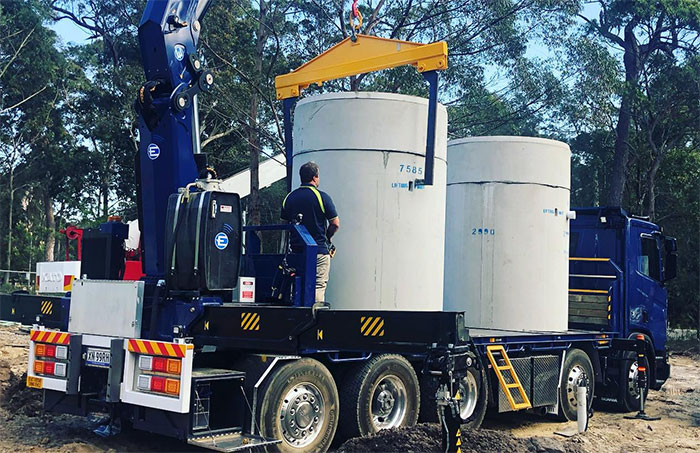
In most cases, in-ground water tanks are delivered to the site on the back of a truck – truck/trailer combo. These trucks can be up to 19 meters long, 2.5 meters wide and can weigh up to ten tonnes. You will also need to take this into account when you are organising your water tanks delivery as there needs to be suitable access to your property for the truck.

If access to your property is via a dirt road if it has been raining heavily prior to delivery will access be affected? Depending on your situation a truck can be reversed down a driveway – if it isn’t too long, but, if the tank needs to be taken down a long road or driveway, there needs to be a suitable turning area that takes into account the length and width of the truck.

You also need to consider the fact that the tank on the back of the truck can be up to 5 meters in height, depending on the tank chosen. Check your road for any power lines and tree branches that may impede access. Allow at least a 5-meter clearance for the tuck and the tank.

Are there any underground septic tanks, or sewers under the access road or turning area that the truck might damage?


The Enduring Durability of Our Tanks

Two of the most common water storage methods are (plastic) polyethylene tanks and underground concrete water tanks. So, if you go online and search ‘tanks in Australia’ you’ll get tons of hits. This can be puzzling and overwhelming because you don’t know how to tell which company offers the best quality and service.

Well, when you shop with Sydney Tanks, we offer a few options that other tank suppliers don’t. That’s why our customers trust us. To start with, we’re friendly and open in all our dealings. We don’t have any hidden costs, and we won’t make a single move unless you’re okay with it. In fact, our first step with any client is a free consult.

Free evaluation and quotation

We’ll send our team to your site, so they can discuss your water storage requirements and inspect your property or premises. Once we have a clear on-ground perspective, we’ll tell you what we think works best for you. We’ll give you a detailed breakdown including price and visual layout, and we’ll do it all without any charges. Submit the free site plan to your local council. We’ll wait for their go-ahead – and yours – before we do anything.

Your tank will have an overflow flap and mosquito mesh to prevent animals and dirty water from entering the tank. Our stainless steel pumps are part of the tank package, and we can install a rain switch too. Once programmed, the switch alternates rainwater and municipal water, triggering itself back and forth when the tank level is too low or adequately high.

Some parts of your home or office collect less rainwater than others, due to barriers or varying topography. That’s why the site visit is so important. As part of our evaluation, we will tell you the best location for your tank, and draft a downpipe plan with turrets in various heights. This system will help you collect the maximum amount of rainwater, and we won’t bill you for the site plan – just the installation if you choose to go forward.

Council-approved installations

If you want one, we can add a First Flush system. It keeps the water clean by ensuring the first water off the roof – the one that probably has accumulated dust and twigs – is led away from the tank. First Flush redirects those first 170 litres of initial rainfall. Our tanks are reinforced with steel and come with a 30-year guarantee. It covers replacement and repair within our terms, so you won’t be left hanging if anything goes wrong. In addition to tanks, we also provide stormwater detention tanks, pits, and grates.

Underground storage has to be strong enough to support the weight above it, but light enough not to crush the tank below. We design our in-ground water tanks with solid, reinforced lids that weigh at most 9.5kg and can handle a load of up to 1,500 tonnes. These lids are locked with stainless steel bolts for added safety, and their 600mm fastenings can easily be opened when you need to clean and maintain the tank.

For quality tanks that last for decades, call Sydney Tanks today on 1800 041 111.

Comparison of Underground and Aboveground Tanks

The importance of water storage cannot be understated. This is why more people all around Australia are getting into water harvesting and storage and installing water storage tanks on their properties. With storage tanks, however, there is the matter of deciding whether to opt for above ground or an in-ground storage tank. Both options have their advantages and their unique drawbacks as well. To help you make an informed decision, we shall take a look at both types of tanks and the benefits they offer.

In-ground Water tanks

These are tanks that are buried inside the ground somewhere within your residence, and the water is then piped up into your home. They come in various sizes, depending on your water storage needs, from 3000 litres all the way to 11000 litres. Some of the benefits of underground water tanks include:

  • They can be installed anywhere on your property, including under your driveway, as long as they are adequately reinforced. Underground concrete tanks are best suited for such an installation. This gives you the freedom to make the best use of the rest of your property.
  • They tend to last longer in comparison. This is because they are completely protected from harmful elements such as heat, cold, tree branches and strong winds, which could damage the tank’s integrity over time. These damaging elements also include wildfires.
  • They literally take up zero space and do not embellish your property. This is one of the reasons why in-ground water tanks are popular in Sydney, where space and restrictions could be an issue.
  • The major disadvantage is the cost if underground water tank installation. The initial cost is however offset by the maintenance costs over time as well as all the other benefits that come with it.

Above ground water tanks

These tanks are installed on a platform, above the ground in your compound. They also come not only in different sizes but also types, with round tanks differing from their slimline counterparts. Here are some of the benefits of installing an above ground tank:

  • The installation process is cheaper as compared to in-ground tanks. This is because you are not required to make any sort of excavation or engineering. The platforms are also relatively cheap to construct.
  • They are easy to clean. Every once in a while, tanks need to be cleaned and silt removed. With above ground tanks, this process is relatively more straightforward, since all that is required is to hose down the inside and tilt the tank to drain out the dirty water.
  • Being semi-permanent, they can be installed in houses where the possibility of moving is imminent, or in places that are rarely occupied. This makes them ideal for campsites and cabins, as well as rental properties.
  • Above ground water tanks are however prone to damage from the elements such as wind and wildfires. They are also open to the effects of temperature changes, reacting to both extreme cold and the harsh heat of the Australian summers.
  • Above ground tanks also come with the possibility of being vandalised or intentionally contaminated. If left improperly covered, they pose a danger to pets such as cats, who have been known to fall into them and drown. They also occupy space in the surface and could be subject to restrictions, unlike many underground tank installations.

What to Expect During the Installation of an Underground Water Tank

When it comes to water tanks, underground tanks have proved to be the most durable and advantageous storage option. Unlike above ground water tanks, underground water tanks can be built to hold a large capacity. They are well hidden below the ground, and this leaves space on your porch for other uses.

In some places within Australia, the winter temperatures can get to chilly lows, and this may freeze the water in above ground water tanks. During summer the stored water heats up, and the temperatures may become overwhelmingly high. Underground water tanks do not suffer this problem. These tanks can maintain water at a constant temperature regardless of the season. Moreover, with an underground tank, your water storage is safe from vandalism and destruction. Here is what you should expect when it comes to underground water tank installation.

The first step in installing an underground water tank involves surveying the site of excavation. Different sites require different approaches when it comes to excavation. Some parts of Australia are rocky, and this may make digging a daunting task. Other areas have unique soils that may be unfavourable for underground tanks. Moreover, the excavators may need to map their digging plan in case your house is in close proximity to the excavation site. Once everything is planned, the excavation can commence.

The size of the tank is entirely dependent on the client. The bigger the tank, the more the need for reinforcement. Most underground tanks are constructed using concrete and more often than not, steel reinforcements are used in the build.

For underground tanks, the piping has to be laid down as the tank is being built. This is because the inlet and outlet systems of the tank are part and parcel of the build. The tanks often have an access route that is normally covered to avoid water contamination. Once the tank is complete, the piping can be hooked to the main water system. A pumping system may be installed alongside the underground water tank. This system builds up enough pressure to get the stored water into the main water system.

Most underground water tanks have an overflow system. The purpose of this system is to prevent the tank from overflowing and flooding your premises. Ball valves have been around since the Victorian times, but they are still used in many water tanks. This simple device closes and opens the water inlet depending on the water level in the tank.

The installation of an underground water tank is a meticulous process. It involves well-calculated planning that starts with a survey of the site. The mixing of the concrete has to be perfect, and there is no room for error. To avoid cracks, the installation process has to be spot on. A well-installed tank will serve you for years.

What to Expect During The Installation Process

The installation of an in-ground water tank begins with it’s creation at the factory. All tanks are individually wet cast from 40mpa steel fibre reinforced concrete, this means there are no joins between the floor and the walls. Thanks to a one-pour casting a water tight seal is ensured to meet the requirements of AS1546.1 a rigorous manufacturing process is in place. All inlets and outlets are cast in the tank for extra strength, the lid is also bonded and sealed in the factory.

For your security and peace of mind all tanks satisfy the Basix requirements for swimming pools, houses and house renovations in New South Wales, with a 30-year structural integrity guarantee in place with every single in-ground water tank sold.

All tanks are manufactured at our facilities in Sydney’s South-West and delivered to locations all across New South Wales and the Australian Capital Territory.

One of the biggest disruptions during the actual installation process is the excavation. While it can put some home owners *off* having an in-ground water tank installed the long-term benefits of opting for an in-ground water tank outweigh any negatives.

To settle a water tank in the ground, with no visibility and no chances of *floating* it’s important that a large hole is created. It is also important that the hole is not any bigger than it needs to be in order to maintain the integrity of the earth structure surrounding the installation, as this will in its own way assist with support.

Although the removal of earth is inconvenient, once the water tank is in place and the earth has been replaced, you’ll have a water tank you can’t see, leaving your views uninterrupted. If you have a small yard where space is critical, you don’t want precious space being taken up by a water tank.

Once the hole has been created, the tank is lowered into the hole by a crane, gaps around the tank are backfilled by sand, or metal dust and cement dust. The tank is filled with water to check for stability, pipes etc are fitted in place and the top section of the tank is covered over.

In-ground water tanks are a reliable way to store natural rainwater for your home, without taking up additional space, allowing you to keep your space, but reduce your water bills.

We help you choose the right tank for your needs, with tanks ranging in size from 3,800 litres to 11,500 litres we have the perfect size and capacity for your home. If you need more capacity, we can interconnect tanks to suit your needs. You can use water from tanks you can’t see to wash your car, flush your toilet and water your garden.


The Benefits of Under Deck Water Tanks

If you have very limited space in your back yard, installing a traditional style water tank can be challenging. Under deck water tanks have been designed to fit into those vacant spaces under your decking area, which provides a functional and smart solution to your space issues.

Under deck water tanks work in just the same way as your in-ground water tanks, however because these tanks are under decking access to the top of the tank is restricted, so these tanks come as a sealed unit without an inlet strainer. For this reason, it’s advised that a standard low maintenance leaf filter is installed in an accessible section of your downpipe to stop debris from entering the tank.

Just as with inground water tanks – if you only allow clean water into your tank, you’ll get clean water out.

A 90mm connection is used on the inlet to your tank to ensure a water tight seal, with the overflow working the same way as your standard overflow, with surplus water pipped into the stormwater connection. It’s also recommended that a mosquito strainer is fitted at an accessible point along the overflow pipe for easy cleaning and removal. The outlet of a tank can be connected to your pump, or to additional tanks using a hose and 25mm threaded connectors. Multiple tanks can be linked together provided all the overflow points are on the same level.

Under deck water tanks are a great way to store water in a tank that is out of sight. These low profile under deck water tanks are unique in strength and design because they take the concept of a slimline water tank that you’d have at the side of your house – and turn it on its side.

The benefits of installing an under-deck water tank are –

  • They are made from food grade plastic to the Australian Water Tank Standard.
  • The plastic is UV stabilised, you don’t have to worry about it breaking down.
  • The rainwater tank is completely enclosed so you don’t need to be worried about mosquitos or water quality.
  • Under deck water tanks may be able to connect to more downpipes than traditional above ground water tanks.
  • Under deck water tanks can come in a range of sizes/capacities to allow you to maximise your water storage
  • Multiple tanks can be linked together to increase capacity, they also do not have to be side by side.

Under deck tanks look great – you can’t see them, they don’t take up any space in your yard, just like in-ground water tanks, you wouldn’t know they are there.

We Help Maximise Your Rainwater Collection

Our underground water tanks are, as the name suggests, installed underground which leaves your yard with all the space it had originally, with no unsightly water tank blocking your view. These tanks are strong, built with steel fibre reinforced concrete it means your tank will be watertight and long lasting assuring you of long-term performance.

Our tank manufacturing process is conducted under the Quality Assurance Scheme, this ensures that each and every tank we manufacture complies with the quality requirements of AS1546.1.

When it comes to service, we can’t be beaten, we advise you on the best or most suitable place for your underground water tank and even provide you with FREE site plans ensuring you get easy council approval. We assist you all the way throughout the process from drainage profiles to comprehensive installation information.

For your peace of mind all concrete underground water tanks come with a 30-year structural integrity guarantee. Every tank has a lockable, super strong, yet lightweight access cover for your safety – and that of your visitors.

You can not get a smarter water tank, our Water Mark accredited Rain Switch is cleaver, it automatically sources rainwater from the tank, whenever it’s available. It switches over seamlessly to town water only when your tank levels are low. Once rainwater has refilled the tank the rain switch will automatically switch back to tank water – you don’t have to do a thing. You have an optional display panel as an extra feature – this panel indicates your current water source at any given time.

When you install an underground concrete water tank you could start saving up to 50% off your domestic town water use by safely and easily supplying your outdoor taps and cisterns with rainwater.

House blocks are becoming smaller with water usage regulations becoming tighter, a rainwater tank offers you a way to store rainwater that is reliable and takes up no extra space in your yard. You can maximise your garden space, while reducing your water bills.

All our tanks –

  • Are individually wet cast from 40mpa steel fibre reinforced concrete so there are no joins between the floor and wall.
  • By using a one pour casting a water tight seal is ensured and a rigorous manufacturing process that meets the requirements of AS1546.1.
  • Our rain water tanks satisfy Basix requirements for homes, home renovations and swimming pools in New South Wales.
  • For your peace of mind, we provide you with a 30-year structural integrity guarantee.
  • For added strength all outlets and inlets are cast in the tank, with the lid bonded and sealed in the factory.
  • All underground water tanks are manufactured at our facilities in Sydney’s south-west and delivered by our crane trucks anywhere in New South Wales and the Australian Capital Territory.

Read Also:

Is Summer Time A Good Time To Install A Water Tank?